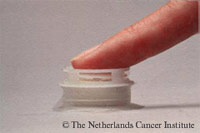
Compliance aspectsIn the above-mentioned clinical trials, however, the compliance with the use of HME’s was not always optimal. Between one-third and a half of the patients discontinued using the device. The two most prominent reasons were: 1. Problems related to the adhesive, such as skin irritation, the adhesion to the skin, loosening of the plaster by coughing and/or forced expectoration while clearing the airway, and 2. Problems with voicing: speech problems occur because patients with a voice prosthesis often experienced difficulties in closing the stoma airtight with a finger on top of the HME, which is needed to be able to vocalize adequately.
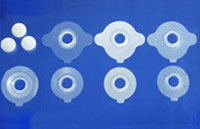
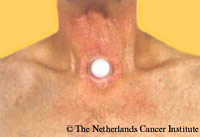
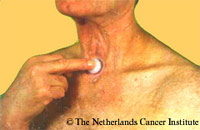
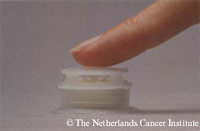
To reduce, or solve the two above-mentioned problems, a new type of HME (Provox HME) was developed.9 The development is also based on and stimulated by ideas and suggestions from some of our patients, who participated in earlier studies and therefore had ample experience with the use of an HME. This new device consists of a disposable plastic housing, which is fixed to the peristomal skin (figure 2) by means of a self-adhesive tape. The housing is available with 3 different types of adhesive tape (Regular, FlexiDerm, and OptiDerm), in 2 sizes (round and oval) (figure 1). Regular is a transparent, perforated standard adhesive. FlexiDerm consists of a thin, transparent, flexible material, which is easy to adjust around deep and/or irregular stomas. OptiDerm is a colloid adhesive with hypoallergenic properties and has a light brown color. For the combination with an automatic speaking valve, such as the Provox FreeHands HME, a more stable Adhesive is available (XtraBase). The actual HME cassette, which is also disposable, contains a heat and moisture exchanging foam, and a speech valve with a spring for airtight digital closure of the HME, and thus the stoma (figure 3,4 and 5). The spring is intended to open the valve after release of the finger pressure. The HME is constructed in such a way that inadvertent obstruction due to clothing or loss of consciousness is prevented to a great extent. There are two versions of the HME with different airflow resistances, i.e. a regular and a low resistance (HiFlow) version. |