Provoxweb

  • General Introduction
  • Voice Rehabilitation
    • 1. The Provox System>
      • Provox1 Voice Prosthesis
        • Provox2 Voice Prosthesis
          • Provox Vega & SmartInserter
            • Provox ActiValve
              • Provox Sizer
                • Provox Dilator
                  • Provox XtraFlange
                    • Provox Brush-Flush-Plug
                      • Provox HME
                        • Provox FreeHands HME
                          • Provox LaryTube
                            • Provox LaryButton
                              • Provox Surgical Set
                              • 2. Surgery>
                                • Primary Prosthetic Voice Rehabilitation>
                                  • Total laryngectomy
                                    • Surgical technique primary TEP
                                      • Primary tonicity control PE-segment
                                        • Tracheostoma construction
                                        • Secondary prosthetic voice rehabilitation>
                                          • Indications
                                            • Preoperative screening
                                              • Surgical technique secondary TEP
                                                • Alternative technique secondary TEP
                                                • Secondary treatment PE segment hypertonicity>
                                                  • Introduction
                                                    • Hypertonicity treatment with Botox
                                                      • References
                                                        • Surgical constrictor pharyngeus myotomy
                                                        • Fistula closure>
                                                          • Indications
                                                            • Surgical technique
                                                            • Stoma revision>
                                                              • Introduction
                                                                • Surgical techniques of tracheostoma reconstruction
                                                                  • Comments
                                                                    • Conclusions
                                                                      • References
                                                                      • Pharynx reconstruction and voice rehabilitation>
                                                                        • References
                                                                      • 3. Replacement>
                                                                        • Indications
                                                                          • Replacement procedures>
                                                                            • Choosing the right prosthesis length
                                                                              • Provox Vega & Smart Inserter
                                                                                • Provox2 voice prosthesis
                                                                                  • Provox1 voice prosthesis
                                                                                    • Replacement of other voice prostheses by Provox
                                                                                    • Additional remarks on prosthesis replacement
                                                                                    • 4. Troubleshooting>
                                                                                      • Introduction
                                                                                        • Device-related replacement issues>
                                                                                          • Leakage through the prosthesis
                                                                                            • Candida overgrowth
                                                                                              • Very frequent replacement due to leakage
                                                                                              • Fistula-related issues and problems>
                                                                                                • Leakage around the prosthesis and the prosthesis is too long
                                                                                                  • Insertion of a Provox voice prosthesis during TEP leading to leakage around the device
                                                                                                    • Leakage around the prosthesis even with the shortest length (4.5 mm)
                                                                                                      • Local infection, prosthesis seems to be OK
                                                                                                        • Local infection, prosthesis displaced
                                                                                                          • Prosthesis extruding from the fistula tract
                                                                                                            • Granulation tissue interfering with the prosthesis
                                                                                                              • Interfering hypertrophic tissue in the TEP area
                                                                                                                • Voicing increasingly difficult, not improved after replacement
                                                                                                                  • Anterograde insertion is difficult due to local infection
                                                                                                                    • Voice sounds strenuous and speaking requires to much effort
                                                                                                                      • There seems to be a 'separation of the party wall'
                                                                                                                        • Voicing is blocked by finger pressure on the stoma/voice prosthesis
                                                                                                                          • Elevated intra-tracheal pressure and effort for voicing
                                                                                                                            • Some bleeding during and after removal of the prosthesis
                                                                                                                              • Prosthesis has disappeared and seems to be ingested
                                                                                                                                • Prosthesis had disappeared and seems to be aspirated
                                                                                                                                  • TE fistula too wide to hold a voice prosthesis, surgery not an option
                                                                                                                                    • Stenosis of the neopharynx
                                                                                                                                      • Anterograde replacement is difficult due to a small stoma
                                                                                                                                        • Deep stoma interfering with application of peristomal devices
                                                                                                                                          • TE fistula deep down in trachea, making replacement troublesome
                                                                                                                                            • TE fistula migrated upwards outside the trachea, voicing problematic
                                                                                                                                              • During retrograde insertion the guide wire gets stuck in the neoglottis
                                                                                                                                                • How much to downsize in case of shortening of the fistula tract
                                                                                                                                                  • Is it possible to remove the prosthesis by pushing the device into the esophagus
                                                                                                                                                  • Voicing problems
                                                                                                                                                    • Algorithm for troubleshooting>
                                                                                                                                                      • Main complaint: Leakage
                                                                                                                                                        • Main complaint: Increased voicing effort
                                                                                                                                                      • 5. Speech Therapy>
                                                                                                                                                        • Introduction
                                                                                                                                                          • Preoperative counseling
                                                                                                                                                            • Outline of voice therapy
                                                                                                                                                              • Important basic principles in voice rehabilitation in prosthetic speech
                                                                                                                                                                • Some points of attention for the 'finishing touch'
                                                                                                                                                                  • General aspects of patient instruction
                                                                                                                                                                    • Problem solving
                                                                                                                                                                      • Conclusion
                                                                                                                                                                      • 6. Hands-free Speech>
                                                                                                                                                                        • Introduction
                                                                                                                                                                          • Provox FreeHands HME automatic speaking valve
                                                                                                                                                                            • Attachment of the valve>
                                                                                                                                                                              • Peristomal attachment
                                                                                                                                                                                • Intratracheal fixation
                                                                                                                                                                                • Assembling and disassembling the HME
                                                                                                                                                                                  • Choosing the membrane
                                                                                                                                                                                    • Proper adjustment of the cough-relief valve
                                                                                                                                                                                      • Using the walk and talk position
                                                                                                                                                                                        • Use of the cleaning container
                                                                                                                                                                                          • Speech therapy. What to practice to optimize hands-free speech>
                                                                                                                                                                                            • Closure of the membrane
                                                                                                                                                                                              • Breath-support/breath-voice coordination
                                                                                                                                                                                                • Phrase length, speech rate, maximum phonation time
                                                                                                                                                                                                  • Pitch, loudness, intonation
                                                                                                                                                                                                    • Shouting
                                                                                                                                                                                                      • Decrease backpressure
                                                                                                                                                                                                        • Hypertonicity/spasm of the neoglottis
                                                                                                                                                                                                          • Hypotonicity of the neoglottis
                                                                                                                                                                                                            • Confusing hands-free TE-speech with esophageal speech
                                                                                                                                                                                                            • Conclusion
                                                                                                                                                                                                              • Troubleshooting>
                                                                                                                                                                                                                • No voice sound
                                                                                                                                                                                                                  • Weak/whisper/aphonic voice
                                                                                                                                                                                                                    • Air leakage under membrane>
                                                                                                                                                                                                                      • Air escaping underneath cough-relief valve
                                                                                                                                                                                                                        • Shortness of breath
                                                                                                                                                                                                                          • Cough-relief valve opens when patient is speaking loud
                                                                                                                                                                                                                            • Seal of the adhesive does not last long
                                                                                                                                                                                                                              • Problems with intratracheal fixation
                                                                                                                                                                                                                                • Too much noise of cough-relief valve when coughing
                                                                                                                                                                                                                                • References
                                                                                                                                                                                                                              • 7. Voice Research>
                                                                                                                                                                                                                                • Introduction
                                                                                                                                                                                                                                  • Perceptual evaluations
                                                                                                                                                                                                                                    • Acoustic analyses
                                                                                                                                                                                                                                      • Maximum phonation time
                                                                                                                                                                                                                                        • Videofluoroscopy
                                                                                                                                                                                                                                          • Summary
                                                                                                                                                                                                                                            • References
                                                                                                                                                                                                                                          • Pulmonary Rehabilitation
                                                                                                                                                                                                                                            • Introduction
                                                                                                                                                                                                                                              • Heat and Moisture Exchangers (HME's)>
                                                                                                                                                                                                                                                • Treatment aspects
                                                                                                                                                                                                                                                  • Prevention aspects
                                                                                                                                                                                                                                                  • Provox HME>
                                                                                                                                                                                                                                                    • Compliance aspects
                                                                                                                                                                                                                                                      • Improvements in compliance
                                                                                                                                                                                                                                                        • Improvements in voicing
                                                                                                                                                                                                                                                          • Early post-operative pulmonary hygiene
                                                                                                                                                                                                                                                            • Breathing resistance
                                                                                                                                                                                                                                                              • Newest Provox HMEs
                                                                                                                                                                                                                                                              • Treatment with inhalation medication
                                                                                                                                                                                                                                                                • Conclusions
                                                                                                                                                                                                                                                                  • References
                                                                                                                                                                                                                                                                  • Olfaction Rehabilitation
                                                                                                                                                                                                                                                                    • Introduction
                                                                                                                                                                                                                                                                      • Clinical research on postlaryngectomy olfaction
                                                                                                                                                                                                                                                                        • Clinical research on olfaction rehabilitation
                                                                                                                                                                                                                                                                          • Considerations on postlaryngectomy olfaction rehabilitation
                                                                                                                                                                                                                                                                            • References
                                                                                                                                                                                                                                                                            • Media etc.
                                                                                                                                                                                                                                                                              • References
                                                                                                                                                                                                                                                                                • Copyright information
                                                                                                                                                                                                                                                                                  • Media-downloads>
                                                                                                                                                                                                                                                                                    • Animations
                                                                                                                                                                                                                                                                                      • Video clips
                                                                                                                                                                                                                                                                                        • Sounds
                                                                                                                                                                                                                                                                                          • PDF
                                                                                                                                                                                                                                                                                        New Addition
                                                                                                                                                                                                                                                                                        New program for TE voice quality assessment and acoustic signal typing according to van As et al. (van As CJ, van Beinum FL, Pols LCW, Hilgers FJM. Acoustic signal typing for evaluation of voice quality in tracheoesophageal speech. J Voice 2006; 20: 355-368), an application in the phonetic analysis program PRAAT (see: www.praat.org)
                                                                                                                                                                                                                                                                                        Picture
                                                                                                                                                                                                                                                                                        For updating your knowledge, visit one of the workshops organized by the Global Postlaryngectomy Rehabilitation Academy.
                                                                                                                                                                                                                                                                                        Picture
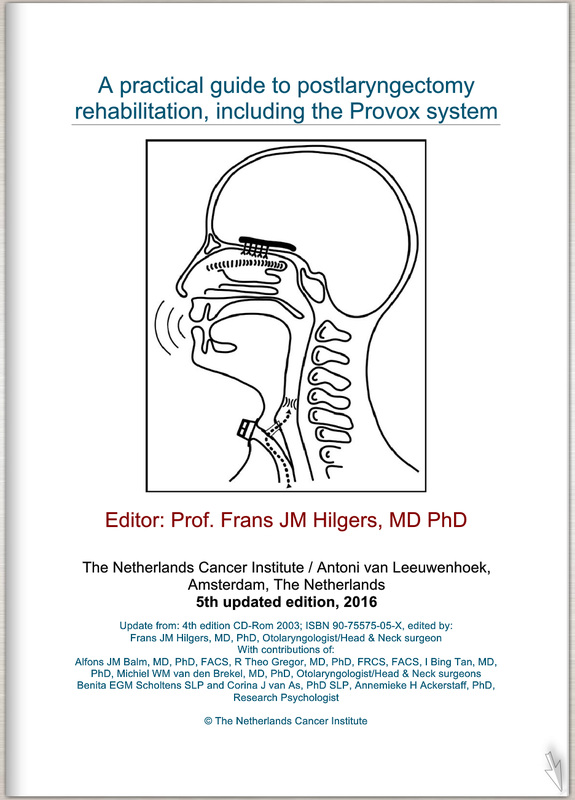
                                                                                                                                                                                                                                                                                        Download the complete PDF of the 4th edition "A practical guide to postlaryngectomy rehabilitation, including the Provox system"; editor: Frans J.M. Hilgers; publisher: The Netherlands Cancer Institute / Antoni van Leeuwenhoek Hospital, Amsterdam, The Netherlands; CD-Rom 2003; ISBN 90-75575-05-X.

                                                                                                                                                                                                                                                                                        Introduction

                                                                                                                                                                                                                                                                                        The increasing use of voice prostheses has improved the prospects of vocal rehabilitation after total laryngectomy considerably. Consistently high success rates have been reported in the last 20 years, after the first description of a useful prosthetic device by Singer and Blom in 1979. Compared with esophageal and electrolarynx speech, a higher percentage of patients achieve an acceptable voice, enabling communication under almost all social circumstances. Success rates up to 90% are not exceptional any longer, making prosthetic voice rehabilitation the method of choice for early and reliable restoration of oral communication after total laryngectomy.
                                                                                                                                                                                                                                                                                        In general, two types of voice prosthesis can be distinguished, i.e. non-indwelling and indwelling devices. The former devices can be removed and replaced by the patient. The latter stay in place permanently and have to be removed and replaced by the clinician at the end of the device life, which is determined by leakage of fluids through the prosthesis or an increased airflow resistance. Indwelling devices have the definite advantage that the patient’s dexterity plays a less important role in the daily maintenance of the device, which mainly consists of cleaning with a brush and/or a flushing device without the need of regularly replacing the prosthesis. Even with increasing age and/or decreasing health a useful (prosthetic) voice can be preserved.
                                                                                                                                                                                                                                                                                        Based on our experiences with surgical and prosthetic voice rehabilitation (Staffieri’s procedure, and the Blom-Singer, Panje, and Groningen prostheses), acquired since 1979 in the Department of Otolaryngology-Head & Neck Surgery of the Netherlands Cancer Institute, we co-developed since 1988 a novel low-resistance, indwelling silicon voice prosthesis, Provox, in close collaboration with the medical engineering industry.1,2 It has been successfully used in our Institute since then in all laryngectomized patients. The long-term clinical results obtained with this voice prosthesis are favorable.3-6
                                                                                                                                                                                                                                                                                        Additional instruments and devices to facilitate its application have been developed as well. 1 Their use, along with the surgical techniques involved and the management of many of the clinical and technical aspects, are the subject of this manual. The subsequent development of a second generation (Provox2) voice prosthesis for bidirectional, i.e. anterograde and retrograde, application is a further improvement of the Provox system.7 The anterograde replacement in the outpatient office has considerably decreased the discomfort of this procedure for the patient and the medical professionals involved.7,8
                                                                                                                                                                                                                                                                                        The problem of post-laryngectomy pulmonary function disorders has also been addressed extensively in our clinic.9-11 The relevance of simultaneous pulmonary rehabilitation for optimal voice restoration and an improved quality of life has become increasingly clear in recent years.12-14 The development of a novel, dedicated ‘valved’ Heat and Moisture Exchanger (HME, Provox HME) has added a new tool to the armamentarium of the clinicians, in this respect.15-17
                                                                                                                                                                                                                                                                                        Hands-free speech is the ultimate goal of postlaryngectomy voice rehabilitation, preferably taking care of pulmonary protection and rehabilitation at the same time. This is now possible with the newly developed Provox FreeHands HME.18
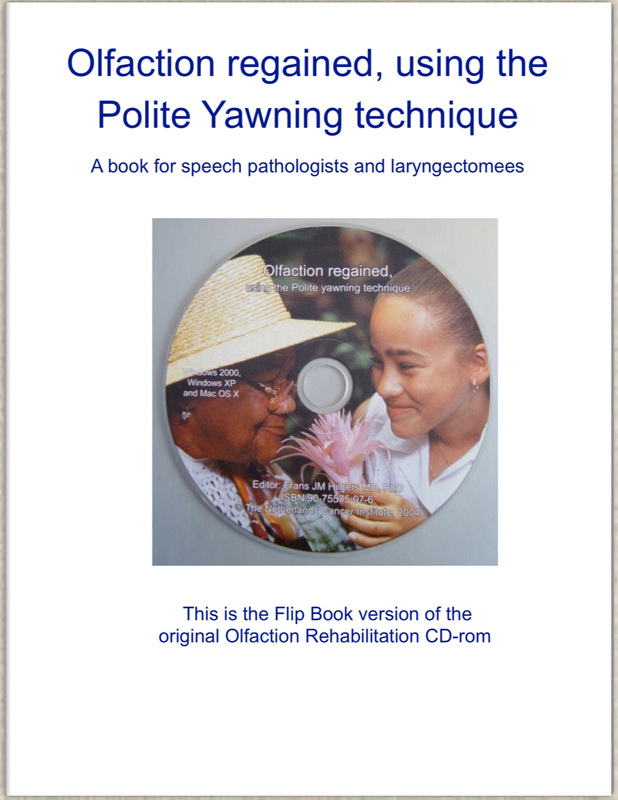
                                                                                                                                                                                                                                                                                        A further problem resulting from the permanent disconnection of the upper and lower airways is a deterioration of the sense of smell. The main cause for this disturbing side effect of total laryngectomy is the lack of a nasal airflow, which normally transports odorous substances to the olfactory epithelium high up in the nose. There are two types of smelling: ‘passive’ and ‘active’ smelling. Passive smelling continuously takes place during normal nasal breathing, whereas active smelling (‘sniffing’) is used intentionally. Re-cent research in our Institute has given more insight in the magnitude of the olfaction problem after total laryngectomy.19 Stoma breathing precludes passive smelling and only some 30% of the patients is still able to actively smell something. However, it now appears to be possible to restore olfaction in a considerable number of laryngectomized individuals. 20,21 The nasal airflow-inducing maneuver (or ‘polite yawning’ technique), which enables active smelling again, will be described in detail.
                                                                                                                                                                                                                                                                                        It should be stressed that vocal, pulmonary and olfactory rehabilitation after total laryngectomy is a multi-disciplinary team effort and that the motivation of the Otolaryngologist, the (head&neck) oncology nurse, the speech therapist and last, but not least, the patient is mandatory to obtain optimal results.

                                                                                                                                                                                                                                                                                        © The Netherlands Cancer Institute - 2003-11; ISBN 90-75575-05-X